
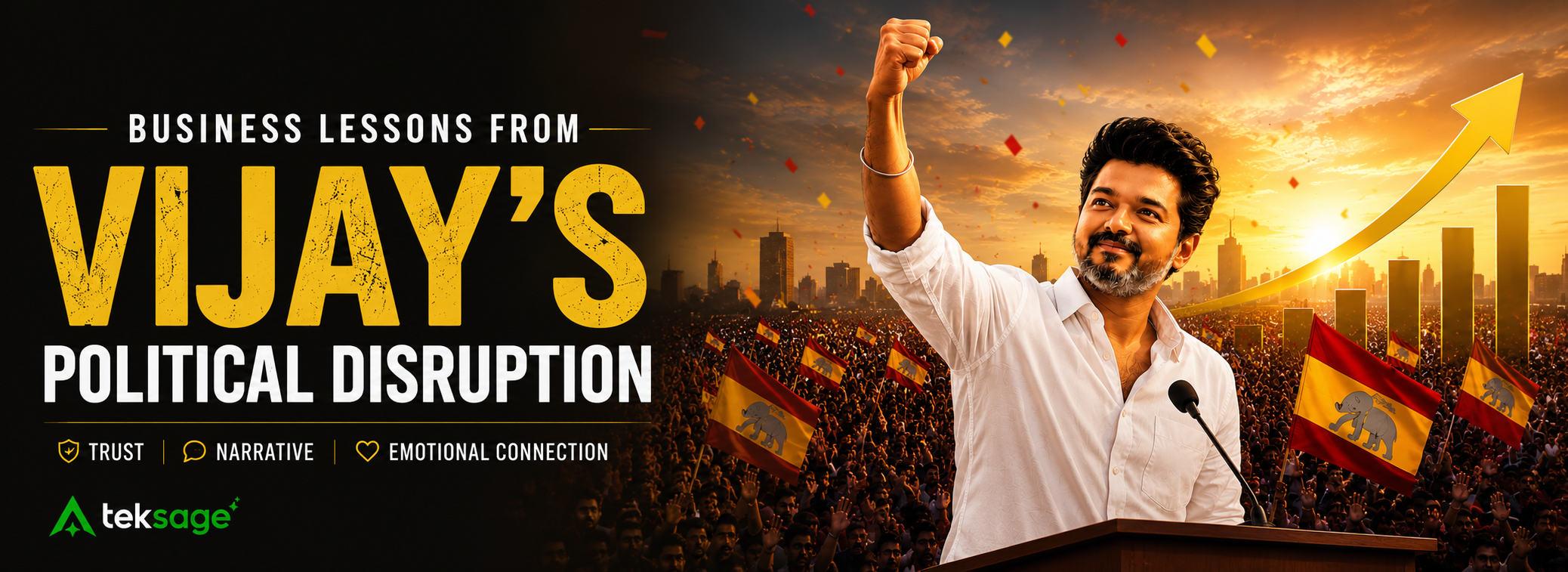
Most businesses spend years trying to build trust. Some individuals walk into a completely new arena—and people trust them on day one.
That’s exactly what we witnessed with Vijay’s disruption in Tamil Nadu’s political landscape. But beyond the headlines, there’s something far more valuable here: a masterclass in market behaviour, positioning, and influence.
If you look closely, this isn’t just a political story—it’s a business playbook.
1. Master One Domain, and the Market Will Trust You in Another
Vijay’s dominance in cinema didn’t just give him fame—it gave him credibility. People didn’t evaluate him as a “new politician”; they extended their trust from what he had already proven.
In business, this is the power of perceived competence. If you consistently demonstrate excellence in one area, your audience assumes your next product or service will carry the same quality. This is why strong brands can launch into entirely new categories and still succeed.
Before diversification, build an undeniable authority somewhere.
2. Emotional Connection Is Stronger Than Functional Value
By addressing his audience as “Anna,” “Nanba,” and “Nanbi,” Vijay wasn’t just speaking – he was relating. He built a sense of belonging, not just support.
Businesses often focus on features, pricing, and performance. But disruption happens when you connect emotionally. Customers don’t just buy products – they buy identity, belonging, and how something makes them feel.
If your product can speak to the customer’s identity, you’re no longer competing – you’re resonating.
3. Even Dominated Markets Have Hidden Demand for Alternatives
Tamil Nadu politics has long been shaped by Dravida Munnetra Kazhagam(DMK) and All India Anna Dravida Munnetra Kazhagam(ADMK). Yet, Vijay’s entry proved a crucial point:
A market can look saturated on the surface but still be psychologically open.
In business, many founders avoid markets that seem “too competitive.” But competition often signals demand. If customers are silently looking for a fresh alternative, even a crowded space can be disrupted.
Don’t just study market share—study market dissatisfaction.
4. Synthesise the Best, Don’t Reinvent Everything
Vijay didn’t position himself in isolation. He acknowledged influences across ideologies—figures like Periyar E. V. Ramasamy and M. G. Ramachandran – creating a perception of balance and inclusivity.
In business, originality is overrated when it ignores learning. Some of the most successful products are not entirely new; they are well-curated combinations of what already works.
Instead of obsessing over uniqueness, focus on intelligent synthesis:
- What do competitors do well?
- What do they miss?
- How can you combine the best into a superior experience?
5. Turn Your Audience into Your Marketing Engine
Vijay’s appeal among youngsters became a strategic advantage. By encouraging them to influence their families, he effectively created a decentralised promotion system.
This is referral economics at scale.
In business, nothing beats trust transferred through a known person. When customers recommend you, the resistance for the next buyer drops dramatically.
The real question is: Are you building something people want to talk about?
Because if you are, marketing becomes multiplication—not effort.
6. Control the Narrative, or the Market Will Define You
One of Vijay’s boldest moves was framing the contest as a direct battle, simplifying choices and making other players seem irrelevant.
In business, customers don’t evaluate every option equally. They respond to the story you create.
A strong narrative:
- Position your product clearly
- Simplifies decision-making
- Reduces competitor visibility
You don’t need to attack competitors, but you must own a clear mental space in your customer’s mind.
If you don’t define your story, someone else will define it for you.
7. Inclusivity Builds Trust, Neutrality Removes Fear
By openly embracing multiple religious spaces, Vijay projected neutrality and inclusiveness. He wasn’t seen as a threat to any group.
In business, customers hesitate when they sense risk, whether cultural, social, or functional.
A truly scalable product:
- Feels safe
- Feels inclusive
- Feels accessible to all segments
Growth doesn’t come from appealing strongly to one group while alienating others; it comes from reducing friction across groups.
Final Thought: Disruption Is Rarely Accidental
What looks like a sudden disruption is often a well-aligned combination of trust, emotion, narrative, and timing.
Vijay didn’t just enter a new domain—he carried influence, shaped perception, and activated people.
That’s exactly what great businesses do.
They don’t just sell. They shift belief.
I’m curious how others see this: Please leave your comment